
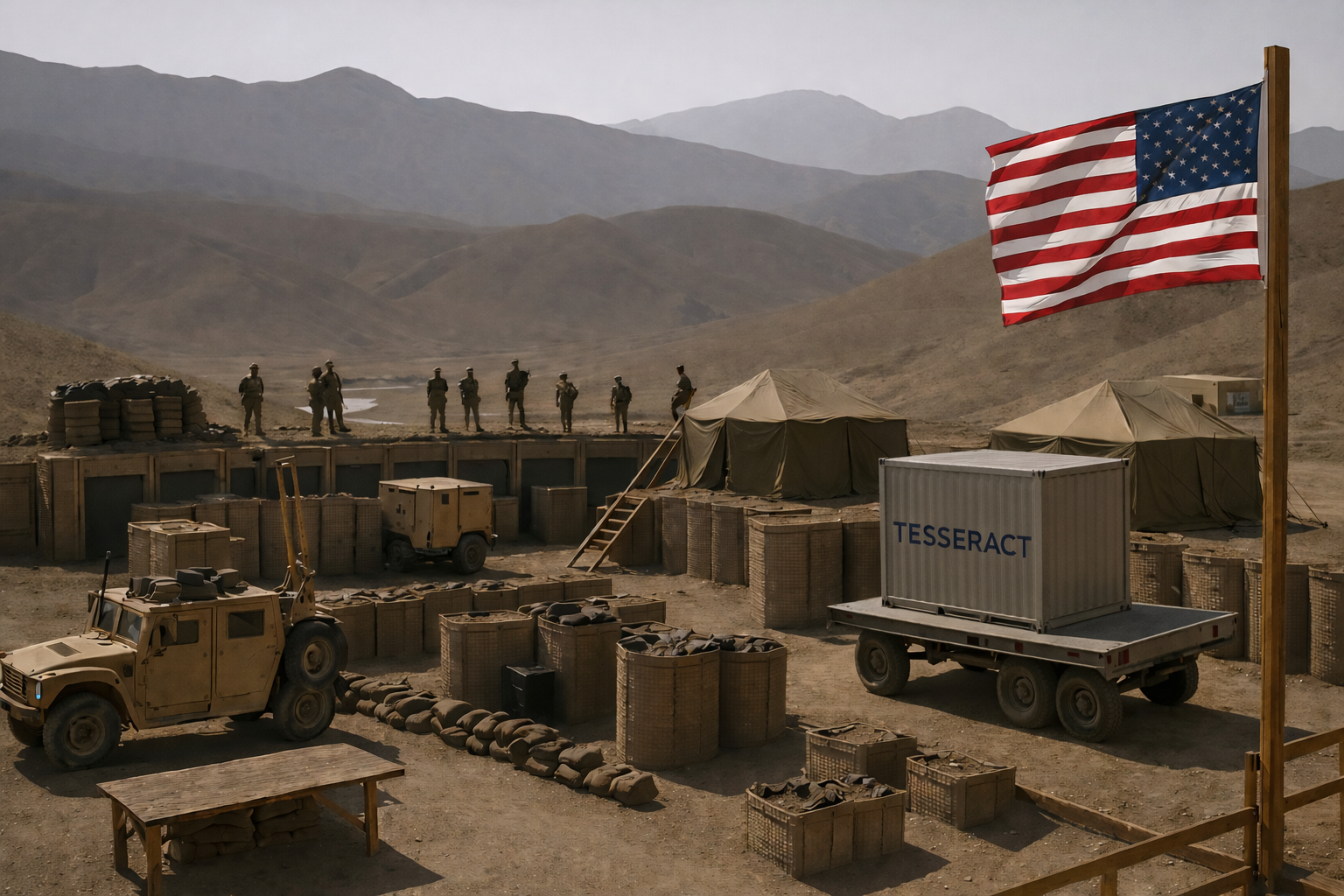
What ZAPP Can Do For You
Focus on the Mission
*
Focus on the Mission *
No more strenuous efforts to secure the power your mission depends on. With Tesseract, energy becomes the last thing you have to worry about. We deliver a simple, safe, clean-energy solution—a complete power system in a box—directly to wherever your mission takes you.
No refueling runs. No complicated training. No maintenance cycles. No interruptions. Just reliable, contained, mission-ready power that works the moment it arrives and keeps working.
Let us help you help the world. Tesseract 4D provides the energy foundation you can trust, so you can stay focused on the operations that matter most. If your mission is critical, your power should be effortless—and now, it finally is.
Business Cases
-
WHY THE DoD BENEFITS
A microreactor like ZAPP eliminates the military’s most vulnerable logistics chain—fuel—by providing a long-duration power source that requires no resupply. It hardens mission infrastructure against cyber disruptions, grid outages, EMP events, and physical attack, ensuring that critical systems remain online in contested environments. By removing the need for continuous fuel transport and generator maintenance, it significantly reduces operational costs and logistical burdens over multi-year campaigns. At the same time, it delivers clean, quiet, persistent power that aligns with the military’s shift toward an electrified battlefield. This stable energy backbone directly supports JADC2, autonomous platforms, directed-energy systems, advanced sensors, and next-generation C5ISR capabilities.
Not to mention—ZAPP is ballistically resilient, engineered for deployment in active conflict zones. Send it to war.
U.S. ARMY – ENERGY DOMINANCE AT THE TACTICAL EDGE
Army operations rely on sustained power for command posts, radar, comms, air defense systems, autonomous vehicles, and forward operating bases. ZAPP provides a stable, long-term energy backbone that diesel simply cannot match in contested logistics environments.
Why ZAPP Works for the Army
Removes the need for vulnerable fuel convoys
Enables long-term forward operating bases without resupply
Powers counter-UAS, radar, EW systems, and integrated air defense
Supports hardened command posts with uninterrupted energy
Functions in extreme climates from desert heat to arctic cold
Operates silently with low signatures for survivability
What ZAPP Enables
Permanent or temporary bases without grid dependency
Continuous power for ISR drones, sensors, and tactical networks
Charging infrastructure for electric or hybrid tactical vehicles
24/7 battlefield data centers, AI/ML nodes, and digital mission systems
U.S. MARINE CORPS – EXPEDITIONARY POWER FOR ISLAND & LITTORAL WARFARE
Marines need power sources that are mobile, resilient, and survivable during distributed operations. ZAPP brings multi-year, autonomous power to remote islands, littoral zones, and dispersed expeditionary advanced bases.
Why ZAPP Works for the USMC
Deployable by ship, LCAC, heavy helicopter, or landing craft
Zero-resupply energy source for isolated island positions
Operates in corrosive maritime environments and extreme humidity
Hardened, low-signature, and tamper-resistant
What ZAPP Enables
Persistent island radar and sensor chains
Expeditionary refueling/charging hubs for drones, boats, and vehicles
Forward command centers with hardened comms and cyber infrastructure
Power for water purification, desalination, and life support
U.S. NAVY – UNINTERRUPTED POWER FOR MARITIME OPERATIONS
Naval missions increasingly depend on shore-side resilience, especially when operating in forward bases or partner nations where infrastructure is unreliable. ZAPP provides the Navy a mobile, modular power plant that brings nuclear-level reliability without the need for naval-reactor infrastructure.
Why ZAPP Works for the Navy
Ideal for remote coastal bases, islands, and expeditionary ports
Withstands salt, humidity, storms, and maritime climates
Provides hardened energy for ship repair, comms, radar, and logistics hubs
Eliminates dependency on fragile host-nation grids
What ZAPP Enables
Power for unmanned surface/undersea vehicle charging depots
Expeditionary shipyards for repairs and mission reconfiguration
Continuous power for missile-defense radar and air-surveillance stations
Independent energy for humanitarian missions and disaster response
U.S. AIR FORCE & SPACE FORCE – POWER FOR HIGH-TECH MISSIONS
Air and space operations require extreme reliability—for radar, satellites, mission planning, secure networks, and remote airfields. ZAPP provides a tamper-proof, meltdown-resistant power core that keeps Air Force missions operating anywhere on Earth.
Why ZAPP Works for the Air & Space Force
Enables persistent radar, tracking, and early-warning systems
Supports austere airfields where no grid exists
Powers satellite comms, cybersecurity centers, and sensor arrays
Runs continuously through arctic cold and desert heat
What ZAPP Enables
Remote airbases for drones, bombers, and reconnaissance aircraft
Ground support power for directed-energy weapons or high-draw systems
Autonomous launch-tracking and telemetry stations
Secure data-processing nodes for AI, cloud, and C2 systems
-
Facilities like Y-12, Oak Ridge, LANL, and other NNSA/DOE campuses rely on uninterrupted power to support national security missions, precision manufacturing, cyber operations, and critical infrastructure. Power outages—whether from storms, grid failures, or cyberattacks—can halt sensitive operations and create significant safety and security risks. A microreactor like ZAPP provides a hardened, independent power supply that operates for years without refueling, reducing operational costs and eliminating reliance on vulnerable grid connections or diesel backup systems.
Key Advantages
Ensures 24/7 mission uptime for classified and high-risk operations
Reduces vulnerability to grid outages and cyber threats
Lowers fuel and generator maintenance costs
Supports high-energy manufacturing, enriched material processes, and security systems
Enhances overall national resilience and infrastructure stability
-
During hurricanes, wildfires, earthquakes, ice storms, and extreme cold events, communities and emergency agencies often lose access to both power and heat—sometimes for days or weeks. In these moments, electricity alone is not enough. Reliable heat, hot water, and sustained power become life-critical.
ZAPP provides a long-duration, fuel-free source of continuous power and thermal energy, enabling uninterrupted electricity, unlimited hot water, and dependable heating throughout the entire response and recovery period. Pre-staged or rapidly deployed, ZAPP can sustain hospitals, shelters, water treatment facilities, command centers, and communications infrastructure—especially in remote or inhospitable environments where cold exposure, frozen systems, and fuel shortages threaten lives. All without fuel convoys or fragile grid dependencies.
Key Advantages
Delivers continuous power and heat when the grid is destroyed or inaccessible
Provides unlimited hot water and reliable heating for hospitals, shelters, medical operations, etc.
Powers emergency shelters, first responder bases, hospitals, homes, and communications
Eliminates fuel delivery challenges during blocked-road conditions
Supports long-duration relief operations without downtime
Reduces FEMA, utility, and state emergency response costs
-
Breakthrough research demands power systems that never stop. Scientific facilities, test ranges, autonomous experiments, and long-duration monitoring stations often operate far from population centers where the grid is weak, unstable, or nonexistent. Many of these environments cannot tolerate power interruptions — shutting down an experiment may destroy years of data, contaminate a sample, damage sensitive equipment, or halt mission-critical testing. ZAPP provides a stable, fuel-free, multi-year power source that enables continuous R&D operations in the most remote and challenging environments on Earth. Its mobility and resilience allow researchers to establish permanent or semi-permanent sites anywhere, without relying on diesel, solar limitations, or fragile infrastructure.
POWER IN ANTARTICA!!
Remote scientific observatories (Arctic, desert, volcanic, or high-altitude sites)
Deep-field environmental monitoring for climate, seismic, and atmospheric studies
Long-duration biological, chemical, and material science experiments that cannot lose power
Autonomous research stations operating months or years without human presence
High-energy test facilities requiring constant thermal stability and uninterrupted power
Space analog habitats and off-grid test beds for lunar or Martian mission simulations
Robotics development sites needing continuous charging for fleets of autonomous systems
Geological and mineral exploration programs in regions with no grid access
Fusion, plasma, and advanced propulsion labs requiring steady baseline power for sensitive equipment
Data collection infrastructure (sensor networks, satellite uplinks, remote communication arrays)
-
SEND ZAPP TO THE MOON!
Establishing a permanent presence on the Moon requires a power source that can survive the extreme cold, long nights, dust, radiation, and isolation of the lunar environment. ZAPP’s sealed, autonomous microreactor design makes it one of the few technologies capable of delivering steady, continuous power for years without refueling. Its compact size allows it to be delivered by commercial launch vehicles and lunar landers, and once on the surface, it can be activated remotely to support habitats, robotics, science missions, and industrial operations that solar or battery systems cannot sustain.
Why ZAPP Works on the Moon
No refueling needed — continuous power during 14-day lunar nights
Immune to dust storms, temperature swings, and shadowed craters
Self-contained, sealed, and safe for launch, landing, and deployment
Can be delivered by commercial rockets and Artemis lunar landers
Operates autonomously with remote monitoring from Earth or Gateway
What ZAPP Enables on the Lunar Surface
Power for habitats, life support, and thermal regulation
Mining and processing of lunar ice for water and rocket fuel
Charging stations for rovers, robots, and exploration vehicles
Scientific missions requiring uninterrupted power
Large-scale manufacturing, 3D printing, and construction
Why NASA Benefits
Provides reliable baseline power for Artemis long-duration missions
Reduces mass, complexity, and battery storage requirements
Supports lunar industry, science, and infrastructure growth
Aligns with NASA’s long-term nuclear power goals (FSP, Artemis, DRACO)